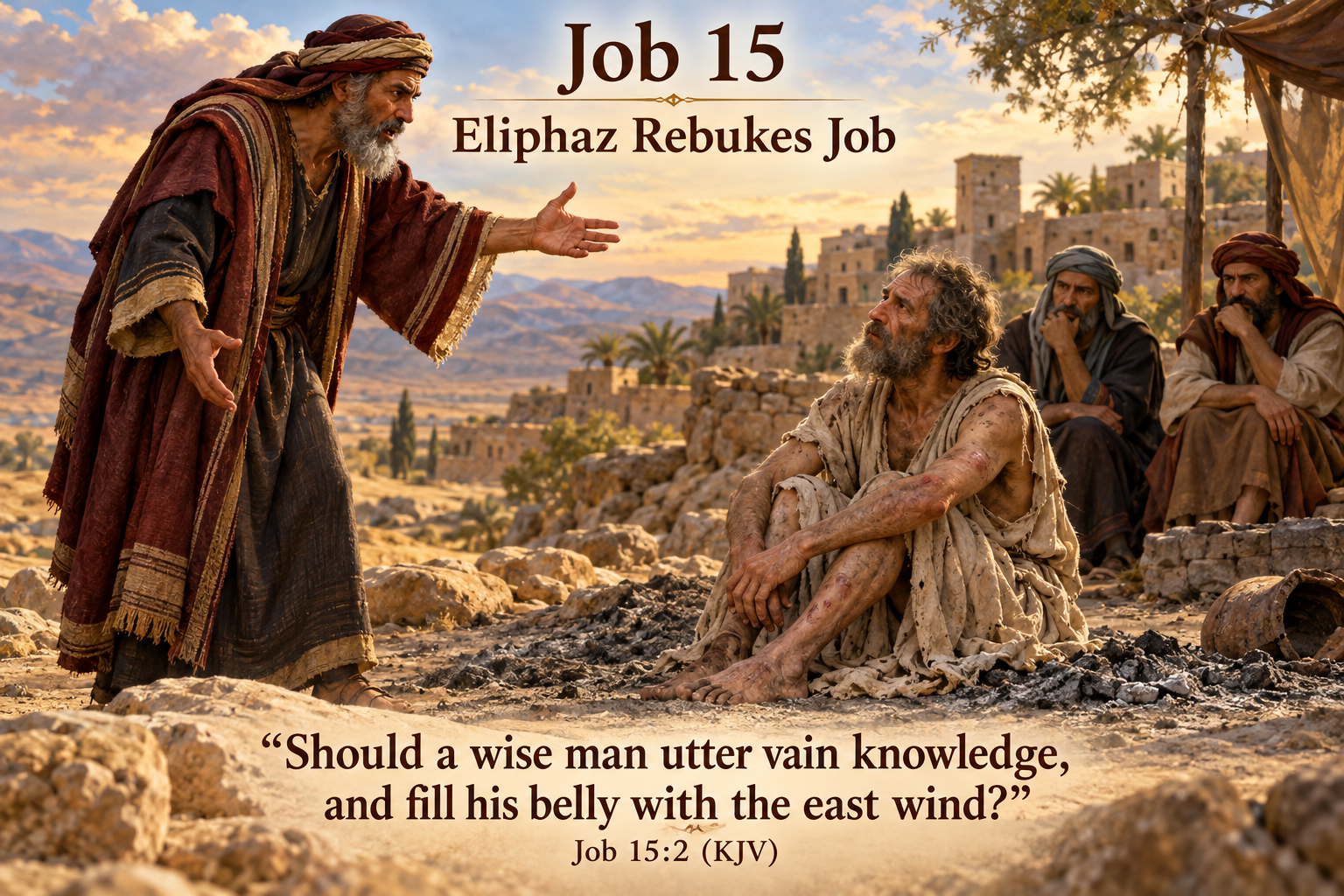
Job chapter 15 records the second speech of Eliphaz, one of Job’s three friends. Instead of comforting Job, Eliphaz becomes more accusing. He believes Job’s words reveal pride and that his suffering must be connected to wickedness.
As we read, we must remember that the Bible faithfully records Eliphaz’s words, but that does not mean all his conclusions are right. At the end of the book, God rebukes Job’s friends for speaking wrongly about Him (Job 42:7).
Verses 1–6: Eliphaz attacks Job’s words
Eliphaz accuses Job of speaking empty words, describing his arguments as wind. He even claims that Job’s speech undermines reverence for God and discourages prayer.
“Thine own mouth condemneth thee, and not I.” — Job 15:6, KJV
Job has been speaking honestly out of deep anguish. Yet Eliphaz treats those cries as evidence against him.
There is a lesson here: someone who is grieving may speak in confusion or desperation. We should listen carefully before deciding that their questions reveal a rebellious heart.
Verses 7–13: Eliphaz challenges Job’s wisdom
Eliphaz asks whether Job was the first man ever born or whether he alone has access to God’s wisdom. He appeals to the age and experience of those on his side.
He also asks why Job rejects the comforts of God. The difficulty is that Eliphaz seems to regard his own advice as God’s comfort, even though his accusations have added to Job’s pain.
Age and experience deserve respect, but they do not make every judgment correct. We must be careful about presenting our own opinions as though God Himself has spoken them.
Verses 14–16: Eliphaz speaks about human sinfulness
Eliphaz asks:
“What is man, that he should be clean?” — Job 15:14, KJV
His broad point is that human beings are sinful and cannot claim moral purity before God.
However, this does not prove his accusation against Job. Job is not sinless, but the opening chapters describe him as upright and God-fearing. His suffering is not punishment for the secret wickedness his friends imagine.
The truth that everyone sins does not mean every hardship is punishment for a particular sin.
Verses 17–26: Eliphaz describes the troubled wicked
Eliphaz now describes a wicked person living in fear, expecting danger and raising himself proudly against God.
Although he presents this as general teaching, the speech strongly implies that Job should recognise himself in the description.
This is where Eliphaz goes wrong: he sees Job’s distress and assumes it reveals Job’s character. But suffering alone cannot tell us whether someone has lived faithfully or wickedly.
Verses 27–35: Eliphaz predicts the downfall of the wicked
Eliphaz describes wealth disappearing, homes becoming desolate, and lives becoming fruitless. He compares the wicked to a vine losing its unripe grapes and an olive tree shedding its blossoms.
These pictures would have been particularly painful for Job, who had already lost his possessions and children. Rather than helping him bear his losses, Eliphaz uses language that makes those losses sound like proof of guilt.
Scripture teaches that wickedness will ultimately face God’s judgment. But Eliphaz wrongly treats that truth as a complete explanation for Job’s present suffering.
What does Job 15 teach us?
- Do not judge someone’s relationship with God by their circumstances. Faithful people can suffer deeply.
- Truth must be applied with wisdom and compassion. A true statement can still be used to support a false accusation.
- Honest questions are not automatically a rejection of God. Job struggles, but he continues bringing his struggle before the Lord.
- Comfort begins with humility. We do not always know why someone is suffering.
Eliphaz thought he understood Job’s situation, but he did not know what the reader had been shown in the opening chapters. Job 15 reminds us to be slow to accuse and ready to show mercy. Sometimes a suffering person needs our patient presence more than our explanation.
For Georges Web Ministries
14th October 2026
Leave a Reply