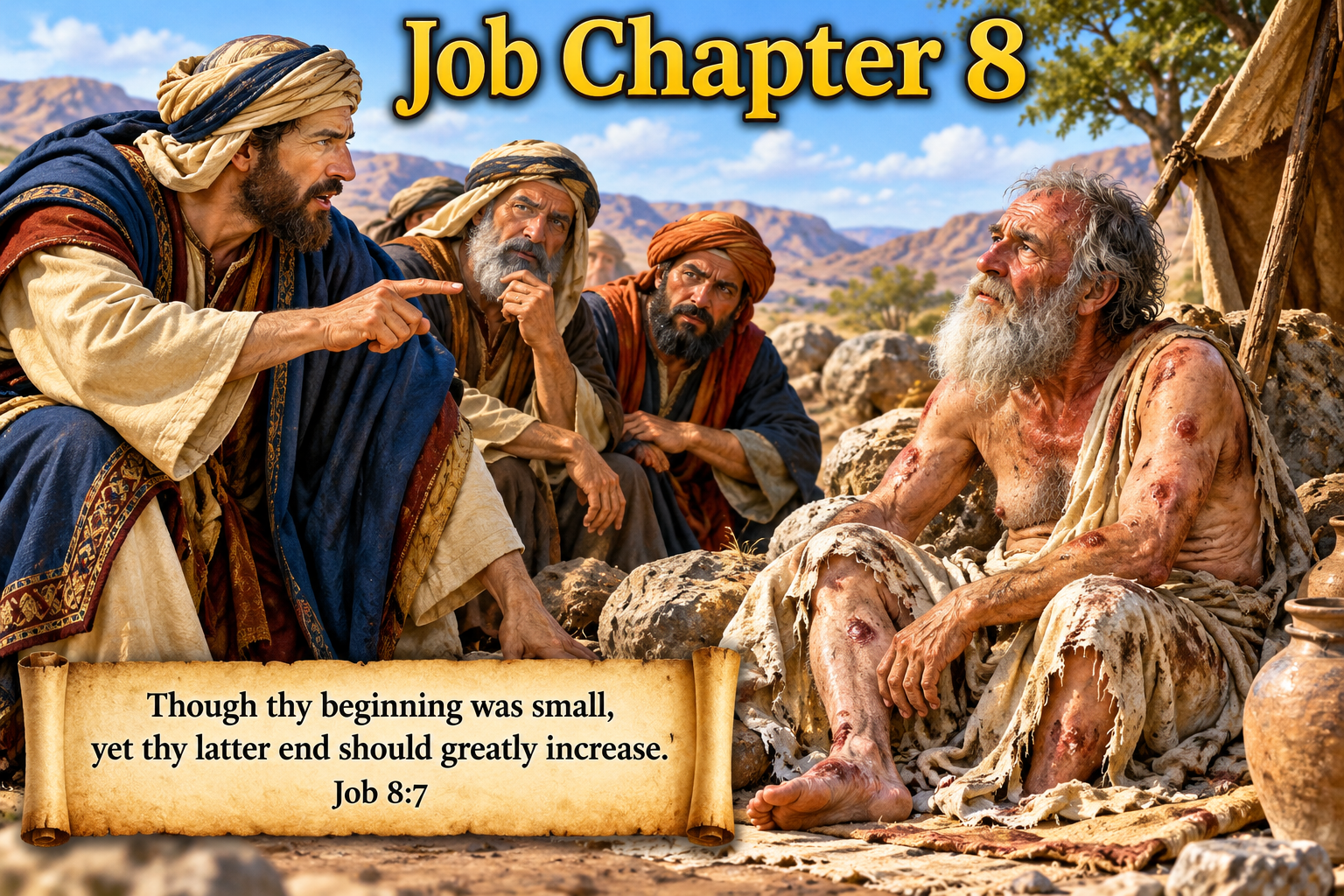
Sermon: When True Words Are Spoken Without Love
Job Chapter 8
Key verse: “Doth God pervert judgment? or doth the Almighty pervert justice?” — Job 8:3 (KJV)
Job had lost his children, his possessions, and his health. As he sat in grief, his friend Bildad began to speak. Bildad believed God was just, and in that he was right. But he made a terrible mistake: he assumed Job’s suffering proved Job had sinned.
Bildad even spoke of Job’s children as though their deaths were punishment for their sins. Imagine saying that to a grieving father. Job needed a friend to sit beside him and listen. Instead, he was given an accusation.
This chapter asks us to examine how we speak to people who are hurting.
1. We do not know everything behind another person’s suffering
Bildad saw Job’s pain and thought he knew its cause. But the opening chapters of Job tell the reader something Bildad did not know. Job’s suffering was not proof that God had rejected him.
We can make Bildad’s mistake today. Someone becomes ill, loses a job, or faces a family tragedy, and we quietly wonder, “What have they done wrong?” There may be times when our choices bring painful consequences, but we have no right to treat every hardship as a verdict from God.
Before we judge someone’s life, we should remember how little of their story we can see.
2. Right words can still be used wrongly
Bildad asked whether God perverts justice. The answer is no: God is just. Yet Bildad used that truth to support a conclusion about Job that he could not prove.
We may know a Bible verse and still use it carelessly. We can speak about God’s justice while forgetting His compassion. We can offer an answer when the person before us first needs someone to weep with them.
Truth matters. So does the way we bring it to a wounded heart.
3. Hope in God is deeper than a promise of quick relief
At the end of the chapter, Bildad says God will fill Job’s mouth with laughter again. Those sound like hopeful words. Yet they come wrapped in the claim that Job must first prove he is innocent.
Job’s story does eventually turn toward restoration, but he must pass through questions and grief that Bildad’s tidy explanation cannot answer. We should never promise a suffering person that everything will quickly return to the way it was. We can tell them something firmer: God hears the cry of the brokenhearted, and they can bring their honest pain to Him.
4. Let us be better friends than Bildad
When someone is suffering, we do not need to explain every mystery. We can visit. We can listen. We can pray. We can offer practical help. And when we speak, we can speak with humility.
Perhaps the words they need are simple:
“I am sorry you are going through this. I am here with you. Shall we pray?”
Job chapter 8 warns us against acting as though we know God’s reason for someone else’s pain. It calls us to hold firmly to God’s justice while treating suffering people with tenderness.
Closing prayer: Lord, forgive us when we have judged people whose burdens we did not understand. Give us wisdom to speak truth with kindness, patience to listen, and hearts willing to help. Draw near to those who are grieving today. In Jesus’ name, amen.
GOD IS A GOOD GOD
GOD KNOWS, GOD LOVES, GOD CARES
Written for Georges Web Ministries.com
Georges WebMinistries. Com
Georges Bible Ministries
Georges Poem .com
29th September 2026
Leave a Reply